Build Up Your Connections
- Luma, a great platform for finding various events around you, including tech-related events. (Recommended by Samantha Betancourt)
- Association for Computing Machinery (ACM) Women, a community for women in computing.
- Break Through Tech AI Program, an initiative by Cornell Tech to support underrepresented students in AI, ML, and data science with skills through industry-hosted projects. They also have another program named as Sprinternships. (Recommended by Samantha Betancourt)
- Rider ACM Club, get together in a friendly environment outside the classroom to adapt skills that benefit you in your future field of study in science and technology.
- Rider Career Development and Success, get one-on-one support to build your resume, hands-on experience of job searching skills, job fairs, and networking opportunities.
- Cybersecurity Jobs, a place for everyone to look for job opportunities in cybersecurity.
- Rewriting the Code, a place to support women students in tech careers. (Recommended by Samantha Betancourt)
- Women in CyberSecurity, a place to support women students in cybersecurity careers. (Recommended by Samantha Betancourt)
- ColorStack, a place to support career opportunities for black or latinx computer science students. (Recommended by Samantha Betancourt)
- SHPE, the nation's largest association dedicated to fostering Hispanic leadership in the STEM field! (Recommended by Samantha Betancourt)
Get your Linkedin profile set up now and start to connect if you haven't already!
Career Opportunities
- Most of the National Laboratories have internship programs open to undergraduate and graduate students. Many of them are especially interested in recuriting students in STEM majors, such as cybersecurity, computer science, and mathematics. Some of the internship opportunities for undergraduate students are listed here, but you can also explore other internship opportunities in the National Laboratories through their websites. Here are some examples:
- Cyber Resilience and Intelligence Division, Oak Ridge National Laboratory
- Internships and Academic Opportunities, Savannah River National Laboratory
- Cyber at Sandia, Sandia National Laboratory
- Student Internships, Lawrence Livermore National Laboratory
- National Security Internship Program, Pacific Northwest National Laboratory
- The Fulbright U.S. Student Program, a prestigious international educational opportunity for undergraduate and graduate students.
Resources
- Bureau of Labor Statistics, a source for career and job market information.
- Google Career Certificates, a platform that provides information on various career paths and skills, provided by Google (From Imaa Chukwuemeka).
- Explore graduate school? These links might help:
- GradSchools.com, a platform that provides information on graduate programs and admissions.
- Princeton Review - Graduate School Advice, a platform that provides information on graduate programs and admissions.
- The Ph.D. Experience, by Mihir Bellare.
- So long, and thanks for the Ph.D., by Azuma.
- "It has often been observed the true gain is in the struggle and not in the achievement—a life without a struggle on your part to make yourself excellent is hardly a life worth living." --The Art of Doing Science and Engineering: Learning to Learn by Richard W. Hamming. (A great book to check out on a weekend afternoon!)
- There are a lot of discussions about "taste" in the AI age. What does it mean in engineering? Check out these discussions for more information:
- What is "good taste" in software engineering? by Sean Goedecke.
- What Do Engineers Mean When We Say "Taste"? by Dave Griffith.
- Impact, agency, and taste
FAQs
- Technical competence is the foundation: focus on building a strong foundation in relevant technical skills. A strong GPA is always a great demonstration of your dedication to technical competence.
- Hands-on skills are critical: gain hands-on experience through course projects, research experience with professors, and obtaining relevant certifications, etc.
- Professional Connections are usually the most effective: work closely with the career development and success center to buid professional connections with alumni and professionals in the field. You can also build up your professional network through joining professional organizations, attending professional conferences, etc. Recommendations from your professional network can be invaluable for securing internships and job opportunities!
- Start early: implement the above three suggestions as early as possible, do not wait until your last year to start these preparations.
- Many people become stressed because they think: “How do I look? Will they judge me? Will I make mistakes?” Instead, shift the frame to: “What value am I giving the audience?” That moves your attention away from self-monitoring and toward communication.
- Shaky voice, fast heartbeat, dry mouth, and sweating are normal. Fighting them makes them worse. Learn to live with it.
- Practice your speech in front of a mirror or record yourself to identify areas for improvement. Pactice always makes perfect in public speaking.
1. How should I prepare myself to get an internship or job in cybersecurity or computer science?
Everyone has a different journey for success, but here are some general tips that can help you start a career in cybersecurity and computer science:
2. What are the recommended cybersecurity certificates I should pursue?
For entry-level positions, consider pursuing the CompTIA Security+, SecAI+ certifications, Google Cybersecurity Professional Certificate, ISC2 Certified in Cybersecurity, ISC2 AI Security Certificate, etc. For more advanced roles (after you worked in this field for more than 3 years), the CISSP (Certified Information Systems Security Professional) and CEH (Certified Ethical Hacker) are highly regarded.
3. What is the most important "secret" to succeed in colleges?
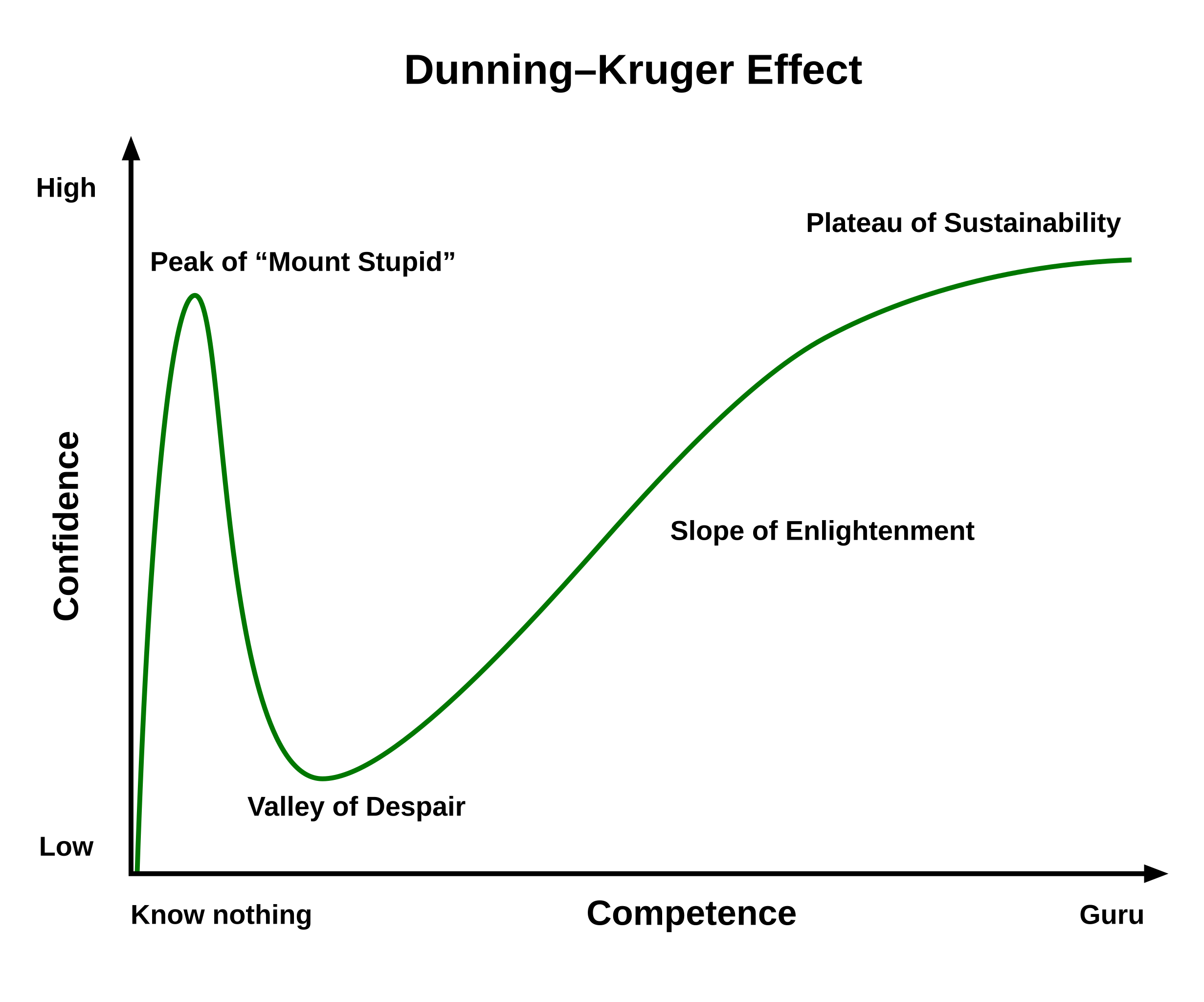
It's resilience. Most of students who choose to drop out they will drop out when they finish the first year of college (during their "Valley of Despair" phase). However, college life usually gets more joyful as you progress and find your footing after that, which can be best illustrated through the "Dunning-Kruger effect curve":
4. Procrastination: Avoiding the Last-Minute Blues
"A tendancy to procrastinate is almost universal. Even when procrastination doesn't lead to failure, it can cause much suffering. Procrastinators work only under pressure, skip classes, give false reasons for late work, and feel ashamed of their last-minute efforts. They also tend to feel frustrated, bored, and guilty more often. Many students equate grades with their personal worth. That is, they act as if grades tell whether they are good, smart people who will succeed in life. By procrastinating they can blame poor work on a late start, rather than a lack of ability. After all, it wasn't their best efforts, was it? Perfectionism is a related problem. If you expect the impossibile, it's hard to start an assignment. Students with high standards often end up with all-or-nothing work habits." -Dennis Coon, John O. Mitterer, Introduction to Psychology: Gateways to Mind and Behavior. 12ed.
5. How could I overcome my stress in public speaking?