Overview
Artificial Intelligence (AI) technologies are transforming daily life, but their rapid adoption has also introduced serious security and privacy challenges. This Collaborative Undergraduate Research Experiences (CURES) program aims to leverage experiential learning to integrate authentic research experiences in AI security and privacy into undergraduate classrooms.
Through this program, students will also gain hands-on experience in the research lifecycle, from identifying research questions to designing and implementing experiments, analyzing results, and presenting findings. The program will also provide opportunities for students to develop leadership skills, critical thinking abilities, and career readiness in cybersecurity, computer science, and related fields.
Learning Resources
- Learning resources:
- CyberGym is a large-scale, high-quality cybersecurity evaluation framework designed to rigorously assess the capabilities of AI agents on real-world vulnerability analysis tasks.
- Hugging Face is the platform where the machine learning community collaborates on models, datasets, and applications.
- Kaggle is a platform for data science competitions and collaboration, where users can find datasets, share code, and participate in challenges.
- Claude Mythos is an AI model developed by Anthropic for cybersecurity and biology research.
- LeepSpace is a free research-grade AI workspace. Try it when you're working with your research projects.
- Stanford Agentic Reviewer is a place you can get detailed AI feedback on your research paper!
Guidelines, Milestones, and Evaluation
- A research project is a systematic and comprehensive investigation aimed at analyzing and evaluating a specific question or hypothesis. In this semester, participants will form teams of 2 to 4 students to explore a research topic in AI security and privacy. At the end of the semester, each group will present your findings to the class using either a poster or slides presentation. The general workflow is shown as follows:
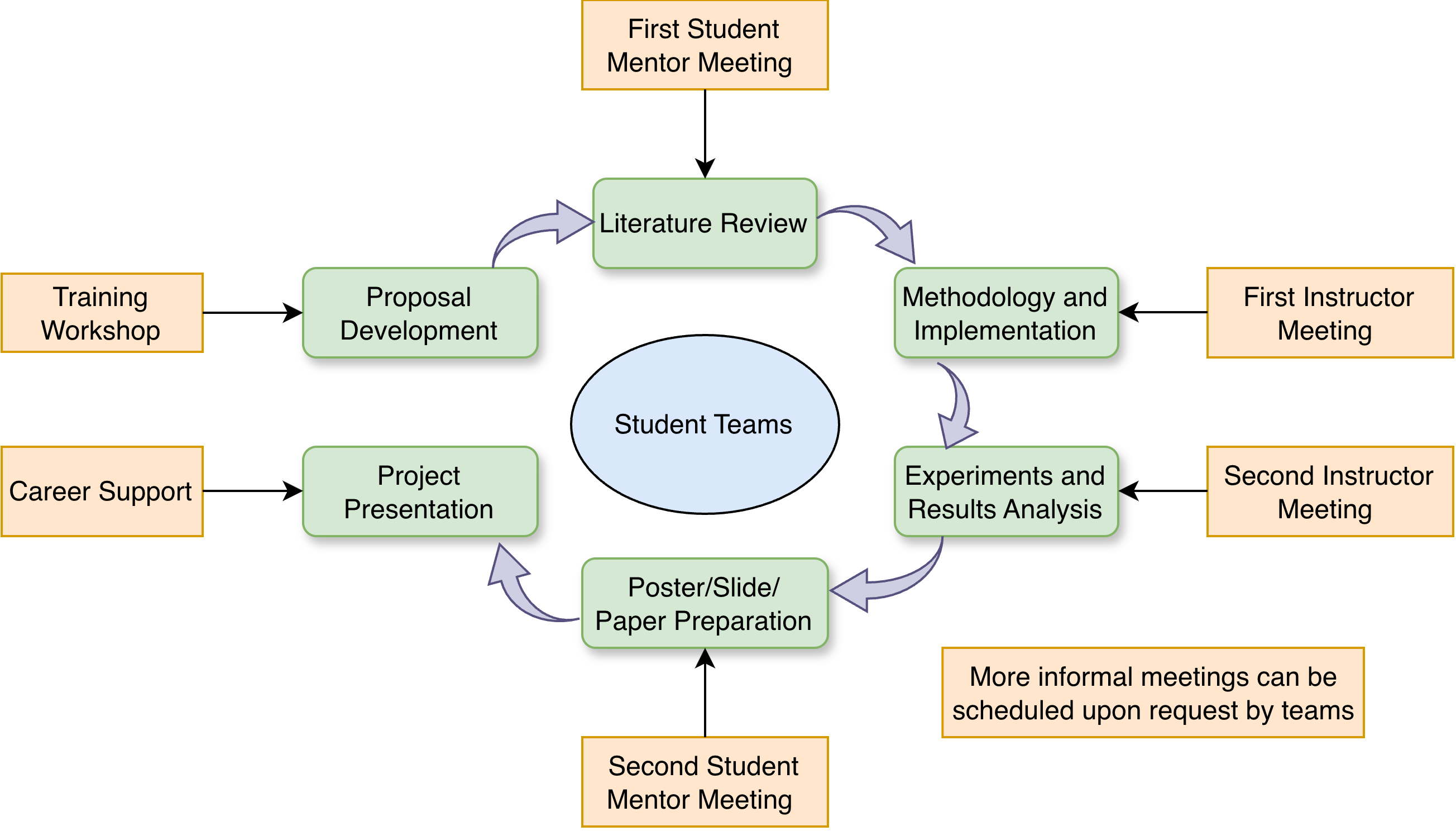
- The project expects three deliverables: (i) a proposal paper, (ii) an implementation and analysis paper, and (iii) a poster or slides presentation. The format of all paper submissions should follow the IEEE Manuscript Templates for Conference Proceedings.
- The project evaluation grade consists of three components: (i) procedure performance (30 points), (ii) peer evaluations (20 points), and (iii) instructor/expert evaluation (50 points), for a total of 100 points.
- Procedure Performance (30 points):
- Proposal (first deadline) (5 points): each team must submit a proposal with at least one full page. The proposal should include three sections: (i) a specific research topic, or overview of the project, (ii) existing literature or related work, (iii) one to two research questions to be explored, and (iv) the planned methodologies.
- Implementation (second deadline) (10 points): each team must submit a short paper (at least two pages) that clearly presents the research questions, methodologies, experimental and implementation details, analysis, and conclusions of the project. The document must be written in a clear, precise, and professional manner.
- Poster/Slides Preparation(third deadline) (15 points): each team must submit a fully-prepared poster or PowerPoint slides. Consider recording your live demonstration beforehand so you don’t have to worry about technical problems during the presentation.
- Changing your term project topic after the initial deadline (note: you are free to revise your research questions) will result in resubmission and re-grade of all previous project submissions. Make-up submissions (including topic changing submissions) for the above three deadlines are allowed, but only 80% of the earned credit will be awarded.
- The grading rubrics used by the peer classmates and the instructor: Recommended Rubrics for Evaluating Collaborative Research Projects.
- Example projects:
Click here to view details
- [Proposal] Investing Prompt Injection Vulnerabilities in AI-Powered Assistants by Jack Sabol, Brendan Cordwell, Joseph Kweku-Osei and Tanmay Agarwal.
- [Implementation] AI-Assisted CPU Scheduling for Mixed Workloads by Dhruv Sethi, Nakul Mittal, Dhruv Mirchandani and Ritvik Sajeev.
- [Poster] Kernel Architecture and Scheduling Algorithms: A Comparative Study by Hector Sapondeleon, Wyatt Damon, and Jose Sandi. The "Best Collaborative Research Project Award" winner of Spring 2026 in CYB 200 Operating Systems and Cybersecurity class.
- [Poster] PhishGuard:A Generative Pre-Trained Transformer (GPT)-powered Phishing Email Detection Solution by Angelina M. Messina, she won the "Best Undergraduate Poster Award" on the Women in Cybersecurity 2025 Annual Conference.
- [Poster] DoS in Action: Comparing the Effectiveness of Four Common Attacks by Ben Raden, Logan Swillinger, Taj Adams, Jack Gottschalk
- [PPT] AI-Assisted CPU Scheduling for Mixed Workloads by Dhruv Sethi, Nakul Mittal, Dhruv Mirchandani and Ritvik Sajeev. The "Best Collaborative Research Project Award" winner of Spring 2026 in CSC 240 Operating Systems class.
- [PPT] Evaluating Data Integrity Attacks on IoT Telemetry Systems by Evan Cho, Ryan Convery,Kevin Hubbard and Nasir Jones. The "Best Collaborative Research Project Award" winner of Spring 2026 in CYB 260 Network Defense and Countermeasures class.
- [PPT] AI & Machine Learning in Network Security by Christina Alli, Samantha Betancourt, Jordyn Bostick, and Vanessa Reino
- [PPT] Security Controls Against File Encryption based Ransomware by Jordyn Bostick, Jack Crane, Kevin Hubbard, and Gabrielle Turco.
- [PPT] Cryptographic Analysis of Data Recovery on crypted Systems by Jack Sabol, Brendan Cordwell, and Tanmay Agarwal.
- [PPT] Privilege Escalation in Linux by Sebastian Lisowski, Vianney Martinez, Stalin Ochoa, Vu Phan An Nguyen.
- [Paper] A Linguistic-based Method for SQL Injection Attack Detection and Defense, published in the Journal of Cybersecurity, Digital Forensics and Jurisprudence, by Moira Geiger, supported by the MacMillan Fellowship for Scientific Research.
AI Student Research Showcase
We are excited to announce the launch of the AISec Student Research Showcase, an event dedicated to highlighting the innovative research projects undertaken by our students in the field of AI, AI security and privacy and related fields. This showcase serves as a testament to the creativity, dedication, and expertise of our student researchers. For more information, please refer to the AISec Student Research Showcase page.
More Information
Click to see the tips for a successful term project
- Please view this project as an opportunity to develop your leadership skills, teamwork spirit, and communication capabilities. They are vital for your future career.
- Please note that all team members are expected to contribute to the term project in a balanced and equitable manner. Throughout the semester, each student has full flexibility to leave a team, join another team, or form a new team at any time.
- Take time to get to know your classmates first—collaborate on class-related tasks and observe each other's strengths. When you're ready, aim to form a team with a diverse set of skills and expertise to enhance your project’s success.
- Choose a topic that genuinely interests your team members. Passion for the subject matter can drive motivation and creativity.
- Work on something that has potential to serve your long-term career goals. For example, a project that could put in your resume, you can talk with your interviewers.
- Conduct thorough literature reviews to understand the current state of research in your chosen area. This will help you identify gaps and formulate relevant research questions.
- Practice your presentation multiple times to ensure clarity and confidence during the actual delivery. Consider recording a rehearsal to identify areas for improvement.
- If you are nervous about public speaking or unsure how to create a presentation, a highly effective approach is to study example presentations such as TED talks, imitate their style, and practice multiple times before your actual presentation.
- How to Conduct a Research Project?
- What makes academic writing rigorous?
- What makes a convincing presentation?
- What makes an effective poster?
- What makes an effective PowerPoint?
Click here to view FAQs
- Q1: Can I work on the same research topic in different courses or across multiple semesters?
- A1: Yes. You are encouraged to build on the same research topic across different courses and semesters. Sustained engagement allows you to deepen your understanding of the literature, refine your ideas, strengthen your research skills, and gradually develop expertise in your chosen area. However, each new course or semester must involve additional work that meaningfully advances your research. For example, you might investigate a new research question, explore a different theoretical perspective, collect additional data, apply a new research method, or extend an earlier analysis. Simply resubmitting previous work or making minor wording changes and add-ups does not meet this expectation. Your work must also meet the specific learning objectives and assignment requirements of each course. Discuss your plans with the relevant instructors in advance, explain how the proposed work builds on your previous or concurrent projects, and clearly identify what is new. Be transparent about any material you reuse, and follow each course’s policies on overlapping submissions and acknowledgment of prior work.
- Q2: Can I change my project topic after the initial proposal submission?
- A2: Yes, you can change your project topic after the initial proposal submission. However, please note that changing your term project topic after the initial deadline will result in resubmission and re-grade of all previous term project submissions. Make-up submissions (including topic changing submissions) for the proposal, implementation, and poster/slides preparation deadlines are allowed, but only 80\% of the earned credit will be awarded.
- Q3: How do I find a good research topic?
- A3: Start by exploring topics that interest you. Consider the relevance and significance of potential topics, review existing literature to identify gaps, and narrow down your focus to a specific research question. Seek feedback from peers, industrial professionals (through job interviews, fairs, etc.) and instructors to refine your topic. Go to job hunting webistes and review job descriptions to identify skills and knowledge that are in demand, and build those skills through your research project. You can always use AI to help you developing your research ideas.
- Q4: How do I find a good research team?
- A4: Start by getting to know your classmates and their strengths. Collaborate on class-related tasks and observe each other's skills and expertise. When you're ready, aim to form a team with a diverse set of skills and expertise to enhance your project’s success. Ensure that all team members are committed to contributing to the project in a balanced and equitable manner. Communication and collaboration are key to a successful research team.
Click here to view related research resources
Professional Conferences & Journals in Cybersecurity
- Want to know the latest research publications from the cybersecurity community? Check out papers from these premier academic venues:
- IEEE Symposium on Security and Privacy (IEEE S&P)
- USENIX Security Symposium (USENIX))
- The ACM Conference on Computer and Communications Security (ACM CCS)
- Network and Distributed System Security Symposium (NDSS)
- IEEE Transactions on Dependable and Secure Computing (IEEE TDSC)
- ACM Transactions on Privacy and Security (ACM TOPS)
- IEEE Transactions on Information Forensics and Security (IEEE TIFS)
- Some of the cybersecurity conferences that focused on industry perspectives:
- Want to make your research more relavent to the Rider community and share your ideas with a broader audience? Please consider submit your work to Rider ISCAP Day.
- Want to submit your research work to external academic vennues or form a team and participate a program contest/catch-the-flag contest? Please visit CCSCNE in Spring semester and CCSCEastern in Fall semester.
Websites
- Our World in Data, a platform that provides data and research on global development issues.
- U.S. Census Bureau, a source for demographic and economic data.
- Gapminder, a platform that provides data and research on global development issues.
- Data.gov, a platform that provides access to a wide range of datasets from various government agencies.
Acknowledgements
This program is supported by the U.S. National Science Foundation (NSF) under Grant No.2551962. We also want to thank our students at the participated institutions for their valuable contributions and feedback.